
In a twist that has left football fans around the globe stunned, Sir Jim Ratcliffe is reportedly preparing to exit Manchester United — just under two years after his highly publicized entry into the club’s leadership. The billionaire businessman, once seen as the savior of the Red Devils, is now said to be selling the iconic club to none other than Elon Musk, the world-famous entrepreneur behind Tesla, SpaceX, and X (formerly Twitter).
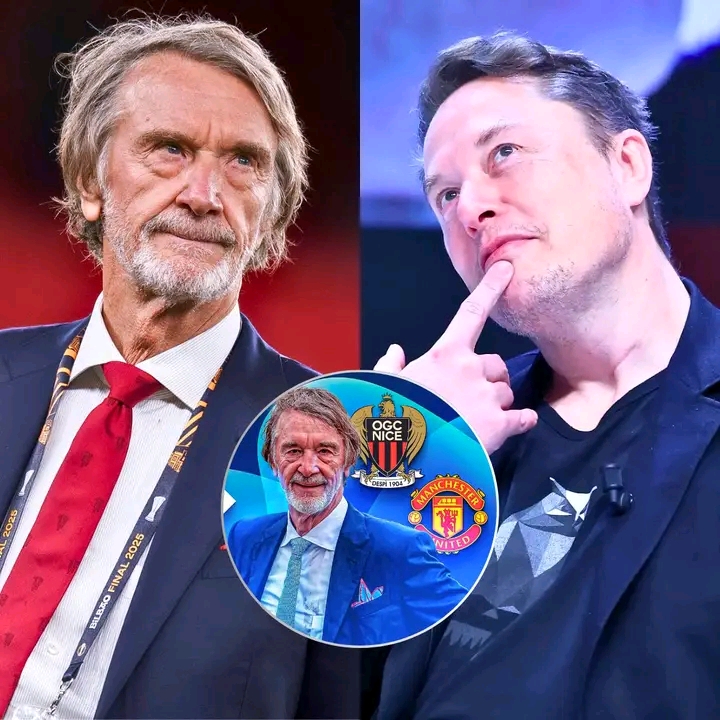
Sources close to the matter claim the deal is worth a staggering $7 billion and could be finalized in the coming days. For many fans, the news feels like the final chapter of yet another turbulent era at Old Trafford.
Ratcliffe’s decision to walk away from Manchester United stems from a growing sense of disillusionment. Since taking partial control of the club, the INEOS chief has endured a rollercoaster of results on the pitch, constant media scrutiny, and backlash from a frustrated fan base. According to insiders, he now believes the energy and resources invested in the club would be better spent developing OGC Nice — the French side owned by INEOS — into a European powerhouse.
“The dream turned into a nightmare,” one source close to Ratcliffe revealed. “Jim believed he could turn United around, but he quickly realized the rot runs far deeper than he imagined. Now, he’s cutting his losses and moving on.”
Elon Musk, a long-time admirer of Manchester United and known for his eccentric tweets about owning the club, appears to be making good on his social media teasers. Unlike Ratcliffe, who aimed for traditional football reform, Musk is reportedly planning to overhaul the club from top to bottom, introducing futuristic systems and Silicon Valley strategies that may shake up the footballing world.
Among his rumored innovations are artificial intelligence scouting systems, drone-assisted training analytics, and the introduction of fan-based cryptocurrency tokens that fluctuate with the team’s performance. While Musk’s approach has created waves of excitement in some corners of the football world, traditionalists are terrified that one of England’s most storied institutions is about to become a tech experiment gone wrong.
Fan reactions have been mixed, to say the least. Some welcome the cash injection and fresh ideas Musk may bring, especially after years of stagnation under the Glazers and now an early exit by Ratcliffe. Others, however, fear that United’s identity — built on decades of legacy, community, and football heritage — could be erased in a flash of algorithms and spectacle.
On the pitch, things haven’t been any more reassuring. A series of humiliating defeats last season compounded frustrations and highlighted the club’s structural issues — from player recruitment to coaching strategy. Ratcliffe’s plans to re-establish discipline and footballing clarity were met with resistance behind the scenes, with sources citing internal divisions and morale issues within the squad.
Elon Musk, for his part, has yet to issue a public statement on the matter. However, insiders suggest that his legal and financial teams have already begun due diligence, with only regulatory approval from the Premier League and final paperwork remaining. Should the transaction go through, it would represent the most expensive club acquisition in football history — and possibly its most controversial.
Meanwhile, Ratcliffe is reportedly already shifting focus back to Nice, where he sees a more manageable project with fewer political hurdles. “At United, you’re dealing with decades of legacy, massive expectations, and unrelenting pressure from millions of fans,” a source said. “Nice offers a clean slate. Jim believes that’s where the real football revolution can happen.”
As the football world holds its breath, one thing is certain — Manchester United stands on the edge of a transformation unlike any it has faced before. Whether Musk becomes the club’s greatest gamble or its unlikely savior remains to be seen.
But make no mistake: if the deal goes through, it won’t just signal the end of the Ratcliffe era. It will usher in an age of football unlike anything the Premier League — or the world — has ever seen.