
Manchester United fans were left stunned this week after discovering a surprising restriction at the club’s official megastore. Despite the excitement surrounding the release of the 2025-26 season kits, supporters were met with a curious notice: names of legendary players Cristiano Ronaldo, David Beckham, and Eric Cantona could not be printed on replica shirts. This unexpected policy has caused quite a stir, prompting many to seek answers.
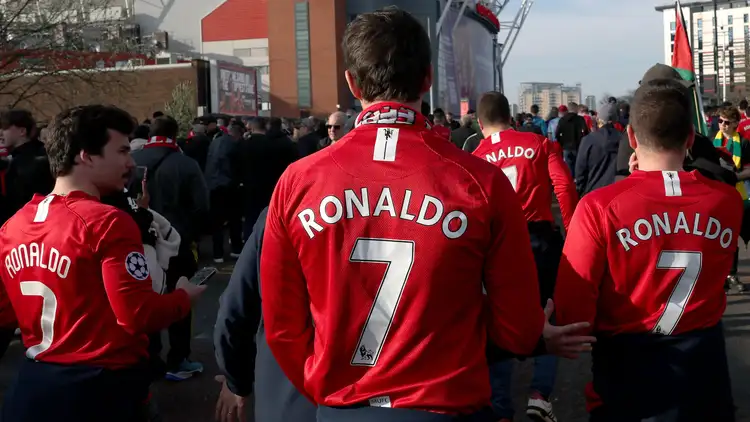
The restriction came to light when a fan named Simon Lloyd visited the Old Trafford store to personalize his newly purchased jersey. Instead of being greeted with the usual custom options, he spotted a digital notice that read, “Due to licensing restrictions, we are unable to print Cantona, Beckham, and Ronaldo.” The message left fans baffled, especially given the popularity and enduring legacy of the three iconic players.
Further investigation revealed the underlying reason behind the decision. According to a clarification provided to The Sun, Manchester United disclosed that the trio—Ronaldo, Beckham, and Cantona—own the rights to their names and images. As a result, the club is legally prohibited from printing their names on merchandise without direct authorization from the players or their representatives.
While this revelation may be new to many fans, it touches upon a long-standing but little-known legal boundary in the world of commercial football. Image and naming rights are a form of intellectual property often retained by elite athletes. It allows them to control how and where their names, faces, and brands are used—especially for commercial gain. Clubs typically need separate agreements to exploit these rights, even for merchandise.
Cristiano Ronaldo, for instance, has built an empire around the “CR7” brand, extending far beyond football into fashion, fitness, and hospitality. Likewise, David Beckham has transformed into a global ambassador for sports and luxury brands, while Cantona maintains a unique and fiercely protected image within football and entertainment circles. Their personal brands hold tremendous commercial value, which they guard meticulously.
The timing of this policy has sparked further discussion given that United’s new kits have just hit the market. For fans who wished to pay homage to past legends by donning shirts bearing their names, the restriction feels like a missed opportunity. Some have even taken to social media, expressing frustration over what they perceive as the club limiting fan expression in favour of legal formality.
Historically, all three players contributed significantly to Manchester United’s storied success. Cantona was the catalyst of the club’s dominance in the early 1990s, Beckham defined an era with his pinpoint crosses and star appeal, while Ronaldo’s impact was felt in two separate spells, especially during his first stint where he helped United win multiple trophies including the Champions League.
However, fans may recall that Ronaldo’s second spell at the club didn’t end on ideal terms. His return in 2021 generated immense hype, but the relationship soured after his public fallout with then-manager Erik ten Hag. The saga culminated in a controversial interview and the mutual termination of his contract. Still, Ronaldo’s name remains one of the most requested by fans—further emphasizing the irony of the printing ban.
Some supporters are now calling on Manchester United to negotiate new agreements with the trio to allow their names on shirts once again. Whether that happens remains to be seen, but it would certainly bridge the gap between tradition and modern branding rights.
In the meantime, United’s pre-season tour continues under new manager Ruben Amorim. The team is currently in the United States and will face Bournemouth next in a friendly in Chicago. While the focus remains on building for the new campaign, the shirt printing controversy lingers as a reminder of how legal nuances can affect even the simplest fan experience.
This incident also raises broader questions about the commercial direction of football clubs and the increasing complexity surrounding player branding. As stars become brands in their own right, fans may have to get used to similar restrictions in the future, especially at the world’s biggest clubs.
Ultimately, Manchester United’s decision reflects both respect for intellectual property laws and the changing landscape of modern football merchandising. While disappointing for many, it highlights just how powerful and protected the names of football’s biggest icons have become.