
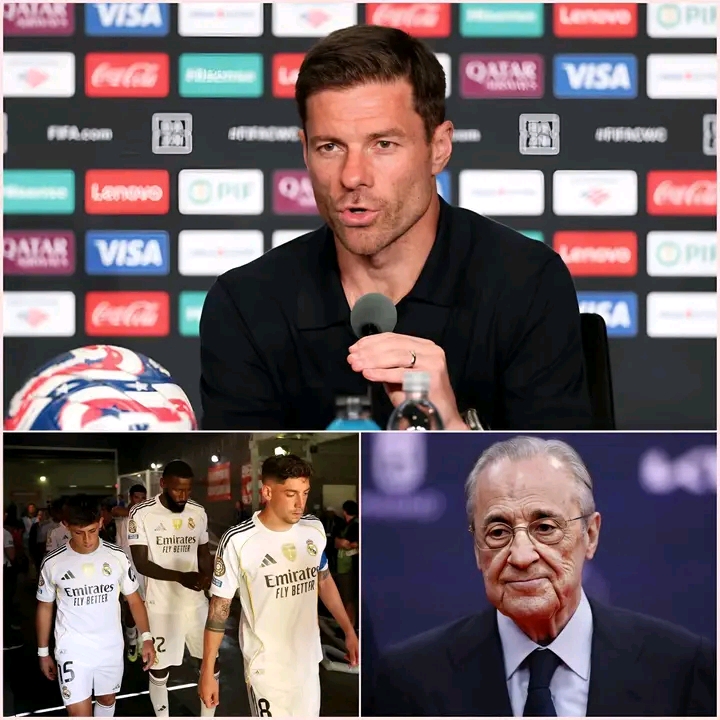
Real Madrid’s shocking 4-0 defeat to Paris Saint-Germain in the semi-finals of the 2025 FIFA Club World Cup has sent ripples through the footballing world, and the aftershocks inside the club are proving just as intense. Head coach Xabi Alonso, clearly infuriated by his team’s dismal performance, singled out three players—Arda Güler, Vinicius Junior, and Marco Asensio—for their inefficiency and demanded immediate disciplinary action. However, club president Florentino Pérez’s unexpected response has thrown the entire situation into a storm of debate.
The match, played at MetLife Stadium in New Jersey, saw Real Madrid humiliated on the world stage by a dominant PSG side led by Luis Enrique. Goals from Fabián Ruiz (a brace), Ousmane Dembélé, and Gonçalo Ramos sealed a humiliating defeat that ended Madrid’s hopes of lifting the prestigious Club World Cup trophy. But what happened after the game quickly became the bigger story.
Alonso, who only recently took over from Carlo Ancelotti, didn’t hold back during his post-match analysis. Behind closed doors, he reportedly pointed fingers at three underperformers: Asensio for a costly error leading to PSG’s opener, Vinicius for his lack of urgency and creativity on the wing, and Güler for a midfield display that Alonso considered “passive and disjointed.” According to insiders, the coach felt betrayed by the lack of fight shown by key figures and demanded harsh sanctions as a wake-up call.
In a tense meeting with the Real Madrid board, Alonso urged Florentino Pérez to impose strong disciplinary actions—ranging from fines to suspensions or benching the players for future matches. Alonso, known for his calm and composed nature, was visibly rattled. “This performance is unacceptable for Real Madrid,” he reportedly told the board. “The standard we set must be met by everyone, or we risk collapse.”
Arda Güler’s name being brought into the spotlight particularly raised eyebrows. The Turkish prodigy has been a rising star under Alonso and was expected to shine in the tournament. However, against PSG, he appeared overwhelmed, failing to assert his presence in midfield and struggling defensively. The performance was a far cry from the confident playmaker fans had grown to admire.
Vinicius Junior’s inclusion in Alonso’s list came as a shock to many. The Brazilian winger, often seen as a cornerstone of Madrid’s future, looked lethargic and uninspired during the semi-final clash. His inability to beat his man or track back defensively left the right flank wide open, allowing Dembélé and Kvaratskhelia to dominate. Alonso felt the lack of defensive support was a betrayal of his tactical setup.
Asensio’s case, however, was less surprising. The once-promising Spaniard has endured a difficult season, struggling with form and confidence. His misplaced pass in the early minutes directly led to PSG’s opener, setting the tone for a one-sided affair. Many fans have since questioned whether he has a future in Alonso’s rebuild.
Despite Alonso’s call for immediate consequences, Florentino Pérez stunned everyone by refusing to punish the players. Instead, he advocated for a more nurturing approach. “We are not here to destroy young players. We are building something new,” Pérez told Alonso, according to reports. “Mistakes are part of growth. They must learn, not be shattered.”
The president’s words have sparked both praise and outrage. Supporters of Pérez’s decision see it as a show of faith in the young talent that Real Madrid has invested so heavily in. They argue that punishing players like Güler or Vinicius, who have carried the team in other matches, would be detrimental to morale and development.
On the other hand, critics believe that Pérez’s leniency could undermine Alonso’s authority. For a manager trying to instill discipline, teamwork, and a competitive mindset, being denied the power to enforce standards could be damaging. Some fans have expressed concern that the club’s structure now places player development over accountability.
Alonso, for his part, has not publicly responded to Pérez’s decision. However, reports suggest he is disappointed and frustrated. Sources close to the coaching staff believe that Alonso sees this as a missed opportunity to set the tone for the future—a moment to show that mediocrity has no place at Madrid.
The incident has also stirred speculation about Alonso’s future. While there is no immediate danger of him stepping down, insiders believe this episode could sow seeds of discord between him and the board. If Alonso feels unsupported, he may struggle to implement his vision in the long term.
As the dust settles, attention now turns to how the players themselves respond. Will Güler bounce back and prove his doubters wrong? Can Vinicius recapture his explosive form? Will Asensio fight to save his Real Madrid career? The answers to these questions could define Real Madrid’s upcoming season.
There’s no doubt that the PSG debacle was a wake-up call. The loss revealed that Real Madrid, despite its world-class roster, remains a work in progress under Alonso. His tactical system requires time, trust, and total commitment from the players—a commitment that, in this match, was clearly lacking.
With the 2025-26 La Liga season on the horizon, all eyes will be on the Santiago Bernabéu. The spotlight will shine brightly on Alonso, his selected squad, and a president whose philosophy now walks the fine line between loyalty and complacency.
Whether this clash of ideologies leads to a stronger, more united Madrid or causes deeper fractures remains to be seen. But one thing is certain: the events of July 10 will not be forgotten anytime soon in the capital of Spanish football.
As the club embarks on this crucial chapter, Madridistas around the world are left wondering: Did Pérez just protect the future—or delay the reckoning?