
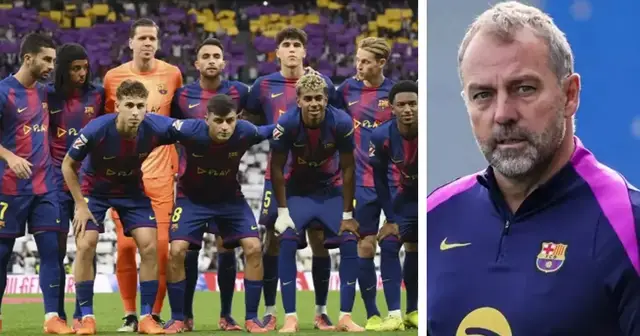
‘He Can’t Pass the Ball to Save His Life’: Culer Insists One Barcelona Player Not the Right Fit for Hansi Flick’s System Anymore
Barcelona’s 2025/26 season has been a chaotic mix of brilliance, inconsistency, and endless injury troubles. Manager Hansi Flick has had to juggle lineups almost every week, with key players like Robert Lewandowski missing significant time. That instability has opened the door for others to step up, but not everyone has managed to convince the fans — and one player in particular, Ferran Torres, has become the latest target of frustration among Culers.
With Lewandowski out, Flick turned to Ferran Torres to fill the striker role. On paper, it made sense: a quick, experienced attacker capable of finishing and pressing high. In reality, the transition has been far from seamless. Torres has scored six goals in 12 games — decent numbers, but the performances behind them haven’t always inspired confidence.
Among the most vocal critics was a Barcelona fan online who bluntly summed up the sentiment: “He can’t pass the ball to save his life. He’s strictly just a poacher, and not even really a good one compared to our other options.” That comment set the tone for a broader debate within the fanbase about whether Ferran fits into Flick’s tactical plans at all.
Hansi Flick’s system thrives on fluidity, passing precision, and movement between the lines. Every attacker is expected to press intelligently, drop deep when needed, and contribute to buildup play. This is where many believe Torres is coming up short. While he’s shown an eye for goal, his link-up play and ability to combine with teammates have come under scrutiny. In a team built on positional interchange, being one-dimensional can quickly become a problem.
The arrival of Marcus Rashford and the impressive form of young talents like Fermin Lopez and Lamine Yamal have only intensified the discussion. Fans now see Torres as an awkward piece in an evolving system. Some insist that the ideal lineup would include Rashford leading the line, with Raphinha and Yamal stretching the flanks and Fermin operating as the creative hub behind them. In that setup, Ferran’s role looks increasingly uncertain.
Supporters argue that Torres works best as a pure striker, but even then, he lacks the killer instinct of a classic number nine. One fan commented that while he scored in the previous game, “in that situation, who wouldn’t, when Fermin gave him a perfect ball?” It’s the kind of backhanded compliment that captures how polarizing his presence has become.
Others argue that Torres should be used strictly as an impact substitute. His pace and positioning could make him useful against tired defenses late in games, but starting him regularly, they say, only exposes his limitations. As one commenter put it, “For me, I don’t want Torres to ever start a game. He can come in as a sub, but he misses too much to be trusted from the start.”
The criticism may seem harsh, but it reflects a larger truth about the modern Barcelona under Flick. This is no longer a side that builds around one or two individuals. It’s a team demanding total synchronization — every player moving, thinking, and reacting as one. A forward who struggles to link passes or adapt positionally can disrupt that rhythm, no matter how many goals he scores.
There’s also the emotional weight of nostalgia at play. Many fans still long for the days of Samuel Eto’o, David Villa, and the Guardiola era — when every forward seemed capable of combining artistry with ruthless finishing. Torres, by comparison, feels mechanical and inconsistent, which makes him an easy target when the team struggles.
Yet it would be unfair to dismiss him entirely. Torres remains a hardworking player who often sacrifices himself for the team. His off-ball runs and pressing help create space for others, even if his technical contributions lag behind. Flick himself has praised his effort and discipline, but even that might not be enough to secure him a lasting place in a squad that’s rapidly evolving.
In truth, this debate says as much about Barcelona’s direction as it does about Ferran himself. The club is rebuilding its identity under Flick — a more modern, adaptable version of its traditional possession game. Players who can’t keep up with that evolution will inevitably fall behind.
So, while “he can’t pass the ball to save his life” might be an exaggeration born of frustration, it captures the essence of the problem: Ferran Torres is a talented player, but in a system built on precision, adaptability, and constant motion, talent alone may not be enough. His future at Barcelona will depend on whether he can evolve fast enough to match Flick’s vision — or risk being left behind as the team moves on without him.