
In a gripping UEFA Women’s Euro 2025 final between England and Spain, a moment of drama unfolded during the penalty shootout that left fans and pundits alike stunned. England’s Beth Mead found herself in an unusual and high-pressure scenario that instantly drew comparisons to an earlier Champions League incident involving Julian Alvarez. The score was tense, nerves were high, and what happened next had echoes of footballing history.
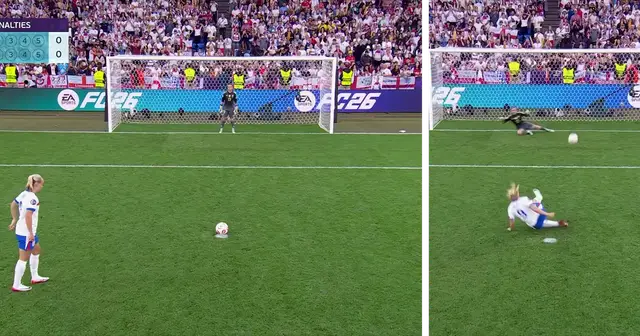
As Mead stepped forward to take her penalty, the atmosphere in the stadium was electric. England had fought hard to stay in the match, and this shootout was going to determine whether they would lift the trophy or face heartbreak. Mead, known for her composure and precision, seemed confident as she ran up to the spot. But then came the slip — the kind that changes games.
Despite the slip, the ball still rolled into the back of the net. At first glance, it appeared that England had taken a step closer to European glory. Fans roared in celebration, and her teammates ran toward her. But the joy was short-lived. As replays were shown on the big screen, the officials began conferring. The crowd fell silent, and confusion began to spread.
Upon closer inspection, it became evident that Mead had made two contacts with the ball. Her standing foot inadvertently clipped the ball just before her striking foot sent it goalwards. This kind of double contact has been a subject of debate in football for years, but under the new rules updated by the International Football Association Board (IFAB), there was clarity on what should happen next.
According to the current laws of the game, if a player commits a double touch during a penalty and the ball enters the goal, the penalty is not immediately disallowed. Instead, the kick must be retaken. This ruling, implemented to ensure fairness and eliminate ambiguity, came as a relief to England supporters who feared the worst — disqualification of the goal and possibly a lost advantage.
The situation drew immediate parallels to Julian Alvarez’s infamous penalty in a Champions League Round of 16 match between Atletico Madrid and Real Madrid. On that occasion, Alvarez also slipped and made dual contact with the ball. But because the incident occurred under the old rules, the goal was simply disallowed with no chance to retake it. Real Madrid fans cheered, while football purists debated whether such technicalities should cost a team so dearly.
This time around, the ruling worked in favor of the attacking player. Mead was granted a second chance — a rare gift in football’s high-stakes environment. With the pressure mounting and history repeating itself in a more forgiving era, Mead refocused, reset her stance, and fired again. This time, there were no slips, no stumbles — just a clean strike that nestled into the corner of the net.
England would go on to win the shootout 3-1, lifting the Euro 2025 trophy and completing a remarkable campaign. But Mead’s penalty moment has already etched itself into football folklore. The debate around double touches, player intent, and rule enforcement is likely to continue, but for now, fans are marveling at the thin margins that can define a final.
The emotional rollercoaster of those few minutes showcased the beauty and agony of the game. Mead’s resilience under pressure highlighted the mental toughness required at the elite level, and the updated IFAB laws proved crucial in ensuring justice was served in real time.
While Spain lamented their missed opportunities and England celebrated, pundits and analysts revisited both the Alvarez and Mead incidents to explore how rules and interpretation can dramatically alter outcomes. Some argued that had the old rule still been in place, England could have been robbed of their moment. Others felt consistency in enforcement is still lacking across competitions.
Regardless, what’s clear is that Mead’s “Julian Alvarez 2.0” moment will be remembered as a defining scene in Euro 2025 — not just for the rulebook implications, but for the sheer drama and courage that surrounded it. Her poise in the face of confusion helped carry England to victory, and her story will be told whenever penalty shootout pressure is discussed.
In the end, football remains a game of inches, instincts, and, sometimes, the slippery surface beneath your feet. For Beth Mead, those inches made all the difference between heartbreak and heroism — a legacy written not in goals alone, but in moments of resilience.